
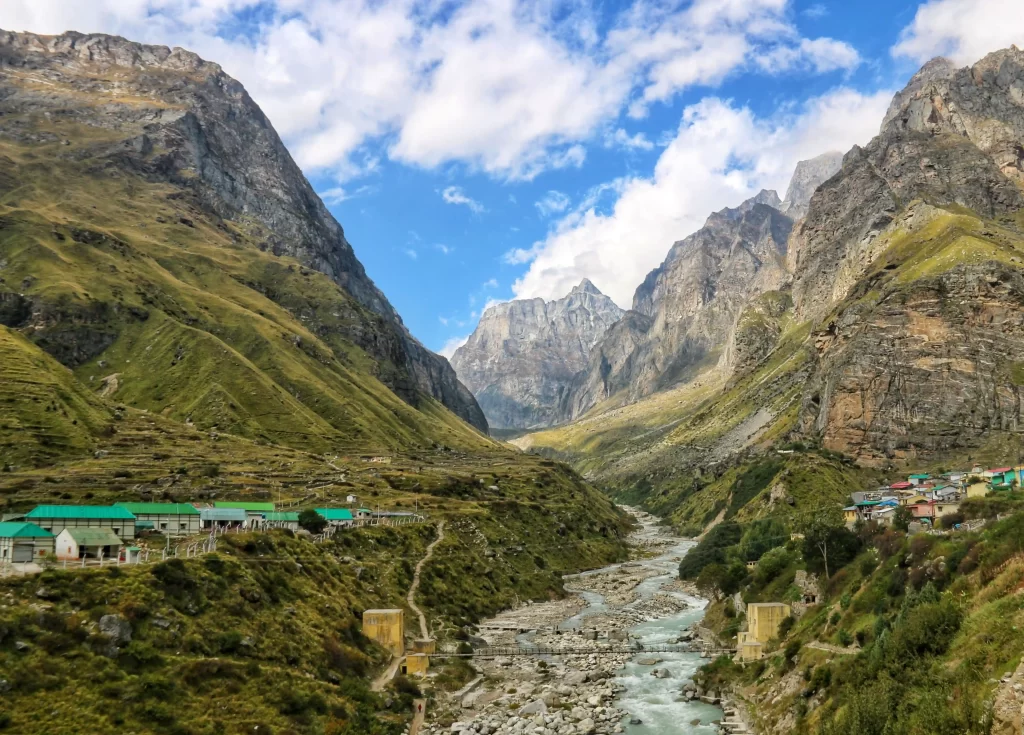
Sometimes a geography lesson is the only way in, and Mana is one of those places where the geography is so dramatic and so final that it makes everything else feel provisional. Mana sits at 10,892 feet in the Chamoli district of Uttarakhand, 3 kilometres beyond Badrinath on the road that ends at the Indo-Tibet border. It is the last village in India before Tibet. The road stops here. The border is close enough to feel. The Saraswati river — one of the mythological rivers of ancient India, said to have disappeared underground centuries ago — runs loud and cold through a narrow gorge just below the village before joining the Alaknanda. And above the village, the peaks of the Zanskar range rise toward the Tibetan plateau in a wall of ice and rock that tells you clearly that you are at the edge of something.
Most visitors to Badrinath visit Mana as an afterthought — a 3 kilometre extension of the Badrinath day trip, fifteen minutes with a camera at the Bheem Pul, and a hurried return to the car. Which is a little like visiting the Taj Mahal and spending most of your time in the car park. Mana deserves more than fifteen minutes. It deserves the kind of slow walking and genuine curiosity that a village at the edge of India has been waiting for.
This guide covers everything about Mana village — the geography, the mythology, the community, what to see and what to do, how to get there from Joshimath, and how to spend a proper amount of time in a place that most visitors underestimate entirely.
Mana Village — At a Glance…
| Location | 3 km beyond Badrinath · Chamoli district · Uttarakhand |
| Altitude | 10,892 feet (3,200 metres) |
| Distance from Joshimath | 48 km — 45 km to Badrinath + 3 km to Mana |
| Community | Bhotiya people — a semi-nomadic Himalayan community with Tibetan cultural roots |
| Season | Open May to October — the village empties to lower winter settlements from November |
| Permit required | No permit required to visit Mana village — it is within the open zone |
| Road access | Motorable road from Badrinath to Mana — accessible by car or a 3 km walk from the temple |
| What it is known for | Last Indian village before Tibet · Bheem Pul · Vyas Gufa · Saraswati river · local woolens |
| Time needed | Minimum 2 hours · half day for a proper visit including Vasudhara Falls walk |
A Small Geography Lesson — Where Mana Actually Is…
Mana sits in the upper Alaknanda valley, where the valley narrows sharply and the terrain changes from the open river landscape around Badrinath to something considerably more compressed and dramatic. The Saraswati river — a tributary that joins the Alaknanda at Mana — comes through a narrow gorge below the village in a roar of white water that is audible from the road above. The Bheem Pul — a natural stone bridge over this gorge — is the most photographed feature of Mana and the one that appears in every Badrinath travel photograph taken in the last twenty years.
Above the village the road continues a short distance to the Army check post that marks the effective end of civilian access. Beyond that point is a restricted military zone — the border with Tibet is approximately 24 kilometres away at the Mana Pass — and the landscape shifts from the alpine Himalayan terrain of the village to the high-altitude desert of the Tibetan plateau in a transition that is visible from the village edge on a clear day. Standing at Mana and looking north is one of the most complete geographical experiences in India — the last buildings of the last village, the border mountains above, and the sense of something enormous beginning just out of reach.
The Bhotiya Community — The People of Mana…
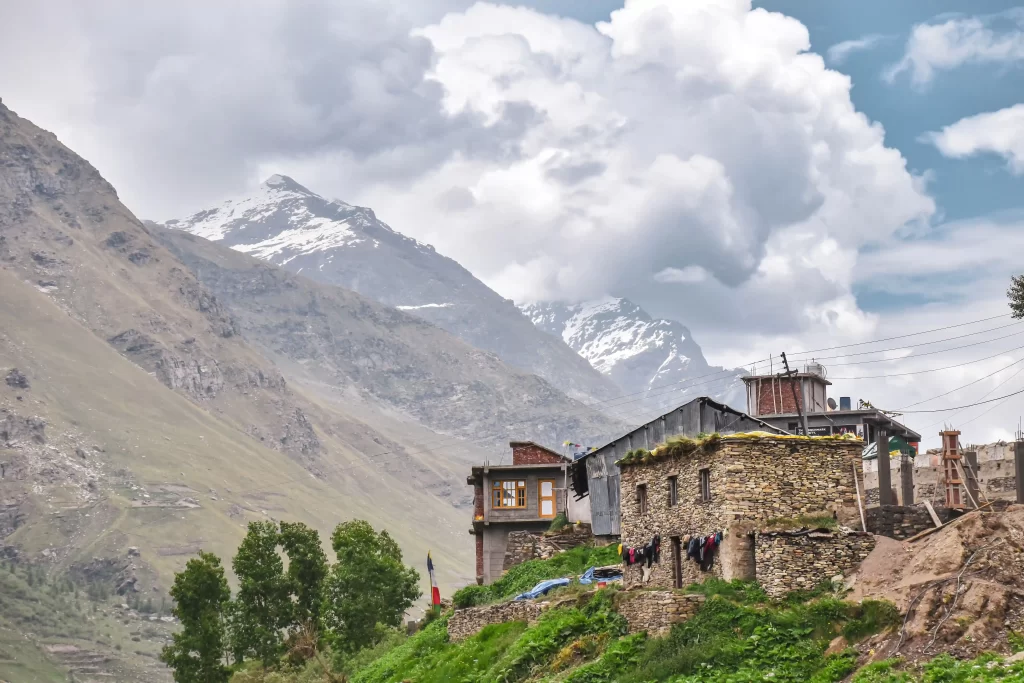
The Bhotiya are a semi-nomadic Himalayan community with cultural and historical connections to Tibet — the name Bhotiya comes from Bhot, the Sanskrit and Hindi name for Tibet. They traditionally moved between summer settlements at altitude and winter settlements in the lower valley, following a pastoral cycle that is thousands of years old. In Mana, the summer settlement is the village at 10,892 feet. The winter settlement is lower in the Chamoli district valley, where the families move when the high altitude becomes uninhabitable from November onward.
The Bhotiya of Mana were traditionally traders — the Mana Pass above the village was one of the historic trans-Himalayan trade routes between India and Tibet, used for centuries to move wool, salt and goods in both directions. The closure of the Tibet border in 1962 ended this trade abruptly and permanently, and the community has adapted over the decades since — tourism, weaving, and local commerce now supplementing the pastoral lifestyle that was always the foundation. The woolens sold in Mana — hand-knitted caps, shawls, socks — are made by the women of the community through the summer season and are among the most genuine craft products available anywhere on the Badrinath route.
Things to do in Mana Village…
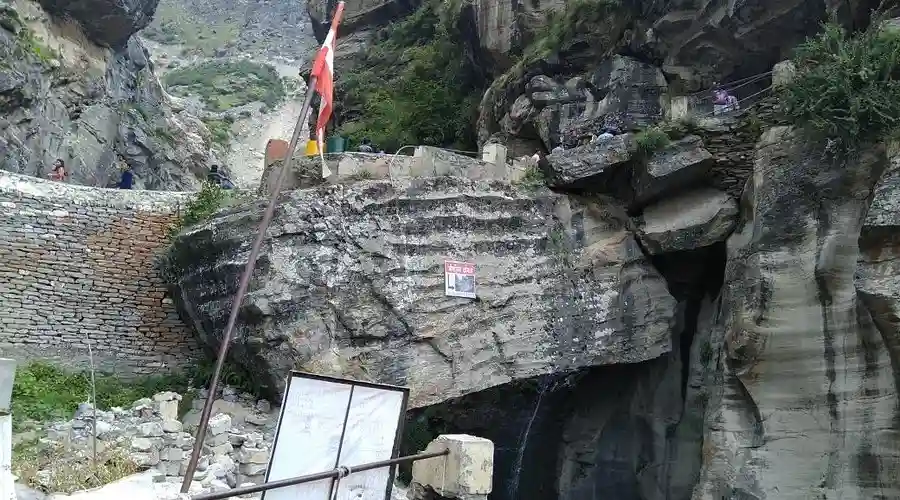
Walk to the Bheem Pul — the natural stone bridge over the Saraswati gorge is the most famous feature of Mana and the first thing most visitors head for. The bridge — a massive natural slab of rock spanning the narrow gorge through which the Saraswati runs in a white roar below — is said to have been placed by Bheem, the second of the five Pandava brothers, for Draupadi to cross during the Pandavas’ final journey to heaven through the Himalayas. Whether or not you hold with the mythology, the bridge itself is extraordinary — a single stone spanning a gorge narrow enough to shout across but deep enough to make the river below look very far away. Stand on it. Look down. Then look up at the peaks above the village.
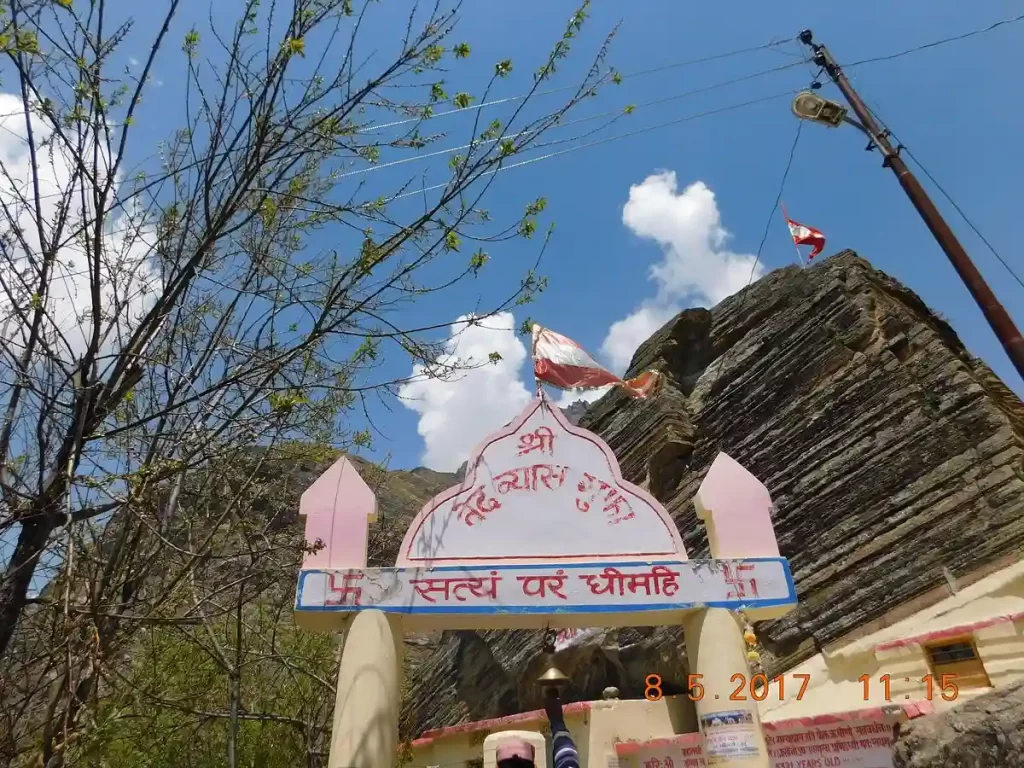
Visit the Vyas Gufa — a natural cave in the rock face above the village where the sage Vyas — also known as Vyasa, the author of the Mahabharata — is said to have dictated the entire 100,000-verse epic to Ganesha, who wrote it down as fast as Vyas could speak. The cave is a small, dark space with a shrine inside and a quality of ancient stillness that is difficult to attribute to anything specific and impossible to ignore. Whether you approach it as a religious site or as a geographical feature associated with one of the world’s greatest literary works, it earns a few minutes of quiet attention.
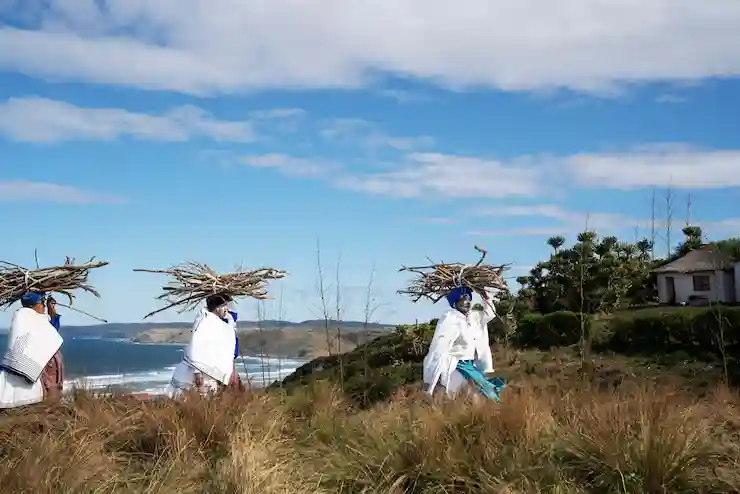
Buy woolens from the village women — the women of Mana sit outside their homes through the summer season knitting wool into caps, socks, shawls and gloves. The wool is local — from the sheep and goats of the community — and the knitting is done by hand in patterns that have been passed down through generations. These are not factory-produced items with a Mana label. They are the actual product of actual hands in the actual village. The prices are reasonable and the purchase is one of those moments of genuine exchange between traveller and community that most tourist experiences approximate rather than achieve. Buy something warm. You will use it.
Eat at one of the small dhabas — Mana has a handful of small tea stalls and dhabas that operate through the summer season, serving the pilgrims and visitors who come up from Badrinath. The food is simple — dal, rice, roti, chai — and the quality varies but the experience of eating at a dhaba at 10,892 feet in the last village before Tibet has a specific quality that no restaurant review can capture. Have chai at minimum. Sit for a while. Watch the village go about its day around you.
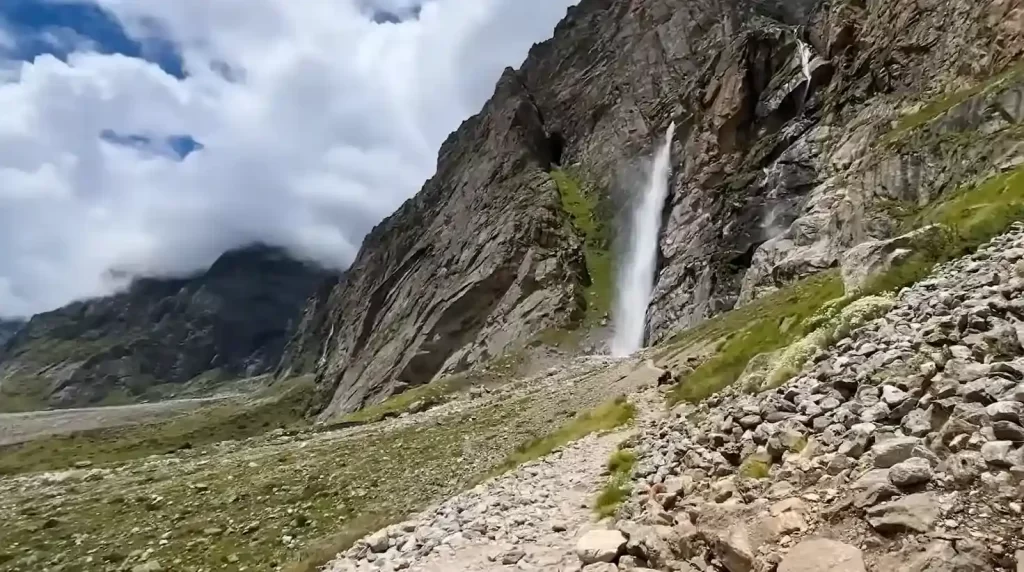
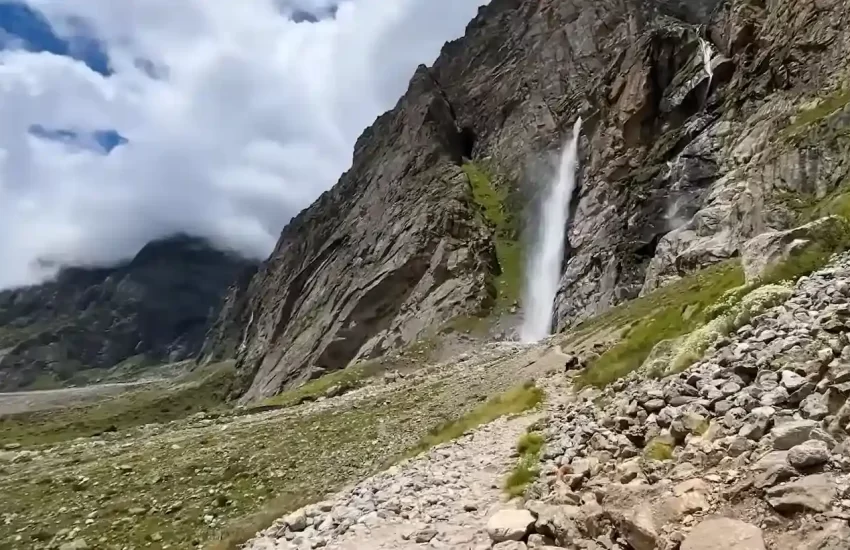
Walk to Vasudhara Falls — 5 kilometres beyond Mana on a gentle trail at over 11,000 feet, Vasudhara is a 400 foot waterfall dropping from a high cliff into a pool below. The trail passes through open alpine terrain with views of the surrounding peaks and in the right season a meadow of wildflowers along the path. The local belief that the water touches only the pure of heart — sinners, the story goes, cannot feel the spray — is one of those pieces of mountain mythology that invites testing. The walk itself is one of the finest short treks available from the Badrinath area and requires no permits or technical preparation beyond warm layers and reasonable footwear. Allow 3 to 4 hours for the round trip from Mana.
Talk to the people who live here — this is the advice that appears in every responsible travel guide and the one that is most consistently ignored because most visitors do not know how to begin. The simplest approach: buy something, ask where it was made, listen to the answer. Or sit at the dhaba and let the conversation come to you. The people of Mana are accustomed to visitors who rush through with cameras and equally accustomed to the occasional visitor who stops and stays for a while. Be the second kind. The village reveals itself to people who give it time.
The Mythology of Mana — What the Stories Mean…
Mana sits at the intersection of two of the great narrative traditions of Hinduism. The Mahabharata — the epic whose composition is associated with the Vyas Gufa — places the Pandavas’ final journey through exactly this part of the Himalayas, ascending toward the heavenly peaks. And the mythology of the Saraswati river — said to be one of the three great rivers of ancient India alongside the Ganga and Yamuna, later believed to have disappeared underground — places its disappearance at Mana, where it joins the Alaknanda before going underground for the rest of its invisible journey toward the plains.
These are not decorative myths applied to a geographical feature after the fact. They are the accumulated meaning of a landscape that has been inhabited and traversed and understood by people for thousands of years — the Bhotiya traders who crossed the Mana Pass into Tibet, the pilgrims who walked from the plains to Badrinath for centuries before the road was built, the rishis and sages whose stories became attached to particular caves and rivers and rocks in a way that has made the landscape inseparable from the narrative. Mana is not a place where mythology happened. It is a place where mythology is still happening — still being told, still being believed, still shaping how the people who live here understand where they are.
Practical Information — Getting to Mana from Joshimath…
The drive from Joshimath to Mana is 48 kilometres — 45 kilometres to Badrinath and then a further 3 kilometres on the road that continues past the temple. The road to Mana is motorable and accessible by car or taxi — most Badrinath day trip vehicles will continue to Mana on request, or drop you at the village and wait. The drive from Joshimath takes approximately 2 hours including the Badrinath section. Leave Joshimath by 6 to 6:30 am for the early morning darshan at Badrinath and then proceed to Mana — this gives you the full morning at the temple and the full afternoon in the village.
Walking from Badrinath to Mana — for those who prefer to walk the 3 kilometres from Badrinath to Mana rather than drive, the road is flat and the walk takes approximately 45 minutes to an hour at a gentle pace. The walk passes through the final approach to the village with the peaks growing steadily closer overhead and the sound of the Saraswati growing louder as you approach the gorge. Walking into Mana rather than arriving by vehicle is the better way to arrive — the village reveals itself gradually rather than all at once.
| Distance from Joshimath | 48 km — approximately 2 hours by road |
| Distance from Badrinath | 3 km — 45 minutes on foot or 10 minutes by road |
| Best approach | Combine with Badrinath visit — temple in the morning, Mana in the afternoon |
| Time to allow | Minimum 2 hours in the village · half day if doing Vasudhara Falls walk |
| Transport | Private taxi from Joshimath · shared jeep to Badrinath then walk or auto to Mana |
| Facilities | Small dhabas and tea stalls · no ATM · carry cash for woolens and food |
| Season | Open May to October — village empty from November |
| Permit | No permit required — Mana is in the open zone |
Things not to do in Mana Village…
Treat it as a photo stop on the Badrinath day trip. Mana is not a set piece. It is a village where people live — the same families, the same houses, the same seasonal pattern of arrival and departure that has been happening here for generations. Arriving with a camera, photographing whatever is most picturesque, and leaving in fifteen minutes is a form of extraction rather than a visit. Give it an hour at minimum. Walk slowly. Put the camera down occasionally and just look.
Photograph people without asking. The women knitting outside their homes, the children playing in the lanes, the old men sitting in the sun — these are people going about their lives, not subjects. The correct approach is to ask, with a gesture or a word, whether you may take a photograph. Most people will say yes. Some will say no. Both answers are correct and both deserve acceptance. The photograph taken with permission is a different photograph from the one taken without it — it has the person’s participation in it rather than their absence from it.
Walk beyond the Army check post. The check post above Mana marks the end of civilian access. Beyond it is a restricted military zone. Do not attempt to go further. The check post is staffed and the restriction is enforced. Mana village and the Vasudhara Falls trail are entirely within the open zone and provide more than enough for a full half-day visit without any temptation toward the restricted area.
Rush Vasudhara Falls. The 5 kilometre walk from Mana to Vasudhara Falls at over 11,000 feet is one of the finest short walks available from the Badrinath area. Trekkers who try to cover it quickly — to get back to the car before the driver gets impatient — are missing the whole point of the walk. The meadow sections, the views of the surrounding peaks, the gradual approach to the falls through increasingly open terrain — all of this rewards a slow pace. Allow the time. Tell your driver in advance how long you will be.Bargain aggressively for the woolens. The woolens in Mana are hand-knitted by the women of the community through the summer season. The prices are already modest — a hand-knitted cap that took several hours to make is not a mass-produced souvenir and should not be negotiated as one. Pay the asking price, or ask politely if there is flexibility. Do not bargain in the way you might at a tourist market. This is someone’s livelihood, not a performance.
OVERRATED
The Bheem Pul as the whole Mana experience. The natural stone bridge is the most photographed thing in Mana and for good reason — it is genuinely extraordinary. But visitors who walk to the Bheem Pul, photograph it, and walk back to the car have seen one feature of a village that has considerably more to offer. The Vyas Gufa, the woolens market, the dhabas, the walk to Vasudhara — all of these are available in the same half day and all of them add dimensions to the Mana experience that the bridge alone does not provide. The Bheem Pul is the beginning of Mana, not the end of it.
The idea that Mana is interesting because it is ‘the last village’. The last village designation is geographically accurate and makes for a compelling travel headline. But it is not what makes Mana interesting. What makes Mana interesting is the Bhotiya community and their history, the mythology of the Saraswati and the Mahabharata, the woolens and the dhabas and the people sitting in the sun outside their stone houses, the specific quality of light at 10,892 feet in the upper Alaknanda valley, and the walk to Vasudhara Falls through terrain that very few visitors to Badrinath ever reach. The border is the context. The village is the substance.
Staying at Blackberry Cottages & Resort for your Mana Village visit…
Blackberry Cottages & Resort is at Auli Laga, Joshimath — 48 kilometres from Mana village and the natural overnight base for anyone visiting Badrinath and Mana on the same day. We arrange early morning vehicles to Badrinath that continue to Mana on request — leaving Joshimath by 6 to 6:30 am, reaching Badrinath for the early morning darshan, and then continuing to Mana for the afternoon with the Vasudhara Falls walk for those who want it.
For guests who want to do justice to both Badrinath and Mana in a single day — temple in the morning, Bheem Pul and Vyas Gufa and woolens and dhaba lunch and Vasudhara Falls in the afternoon — we plan the day around that itinerary and make sure the vehicle timing supports it rather than constraining it. The drive back to Joshimath in the late afternoon, with the Alaknanda valley in the evening light and the peaks going gold above the road, is the right end to a day that started at 14,000 feet and ended at 11,000 feet and contained, in between, one of the most complete encounters with the Garhwal Himalayan landscape available from a single base.
Plan your Badrinath and Mana village day from Joshimath at blackberrycottagesauli.com or reach us on WhatsApp.
