
There is a particular type of travel experience that exists just beyond the obvious stopping point — the place that rewards the visitor who walks five kilometres further than everyone else. Vasudhara Falls is that place. It sits 5 kilometres beyond Mana village on a trail that most Badrinath visitors have never taken, at over 11,000 feet above sea level, where a 400 foot waterfall drops from a high cliff into a pool below and the surrounding peaks rise on all sides in a silence so complete that you can hear the mist landing on the rocks.
Most people who visit Badrinath do not know Vasudhara Falls exists. Most who know it exists do not walk to it — they reach Mana, photograph the Bheem Pul, look at the Army check post in the distance, and turn back to the car. Which means Vasudhara Falls remains one of the least crowded and most extraordinary natural sights in the entire Badrinath area, accessible to anyone who is willing to walk a gentle 5 kilometre trail at altitude and not in a hurry to be somewhere else.
This guide covers everything about Vasudhara Falls — the mythology, the trail, the waterfall itself, the best season, what to carry, and how to build it into a full Badrinath and Mana village day from Joshimath.
Vasudhara Falls — At a Glance…
| Location | 5 km beyond Mana village · 8 km from Badrinath · Chamoli district · Uttarakhand |
| Altitude | Approximately 11,155 feet (3,400 metres) |
| Height of falls | Approximately 122 metres (400 feet) |
| Distance from Joshimath | 53 km — 45 km to Badrinath + 3 km to Mana + 5 km trail |
| Trek distance | 5 km from Mana village (10 km round trip) |
| Duration | 2 to 3 hours one way · 4 to 6 hours round trip including time at the falls |
| Difficulty | Easy to Moderate — gentle trail with gradual altitude gain |
| Best season | May to October — falls are at their most dramatic June to August when snowmelt is at maximum |
| Permit required | No permit required — trail is in the open zone beyond Mana |
| What makes it special | 400 foot drop · open alpine terrain · almost no crowds · mythology of purity test · views of surrounding peaks |
A Small Geography Lesson — Where Vasudhara Actually Is…
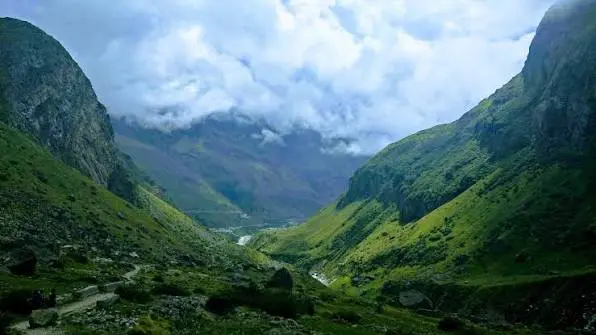
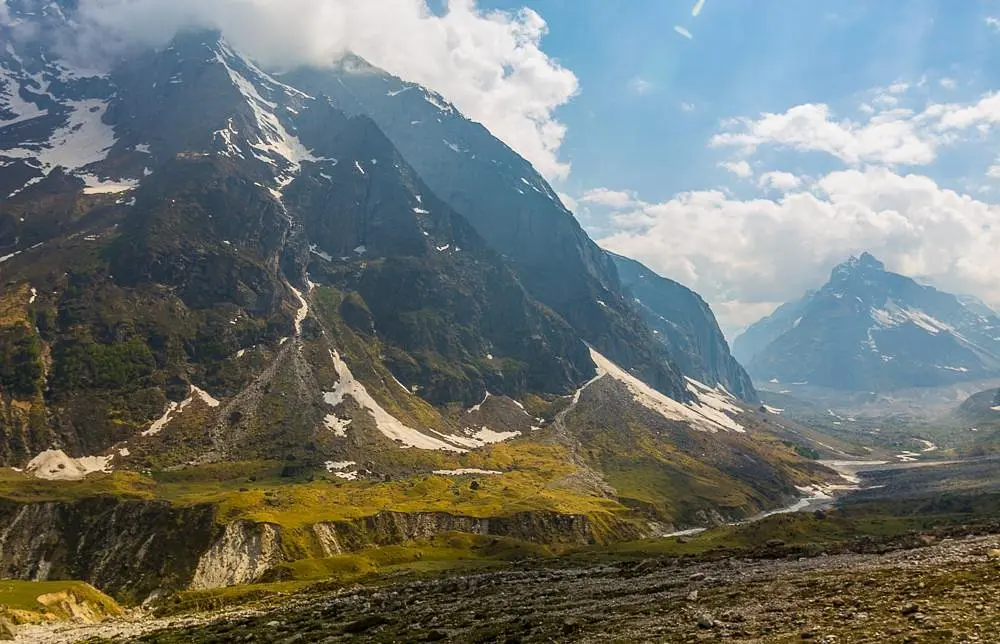
Vasudhara Falls sits in the upper Alaknanda valley above Mana village, in the transition zone between the green alpine terrain of the Chamoli district and the high-altitude desert landscape that begins as the valley climbs toward the Tibetan plateau. The trail from Mana follows the left bank of the Alaknanda through open meadow and rocky terrain, gaining altitude gradually before arriving at the base of the falls where the water drops from a high cliff face into a pool and then continues down toward the main river.
The name Vasudhara comes from the Sanskrit — Vasu meaning wealth or jewel, and Dhara meaning stream or flow. The Stream of Jewels. Which sounds like a name applied after the fact by someone who saw the waterfall on a clear morning when the light was catching the spray and the mist was doing something photogenic. But there is also the mythology — Vasudhara is associated with Kubera, the lord of wealth in Hindu mythology, and the falls are considered sacred by local belief. The most famous aspect of this mythology is the purity test.
The Mythology — The Purity Test…
The local belief attached to Vasudhara Falls is one of those pieces of mountain mythology that is impossible to verify, entirely enjoyable to contemplate, and perfectly suited to the location. The belief holds that the water of Vasudhara touches only the pure of heart. Those who have sinned, the story goes, cannot feel the spray — the water curves away from them before it lands. Those who are pure receive the full blessing of the falls. Whether you stand under the spray and feel it or do not feel it is between you and whatever you think purity means. What is certain is that standing at the base of a 400 foot waterfall at 11,000 feet in the Garhwal Himalayas, with the surrounding peaks above and the silence of the upper valley around you, produces a very specific quality of experience that the mythology is simply trying to describe in the language available to it. Something happens at Vasudhara Falls that is difficult to name. The mythology names it purity. The traveller can name it whatever feels accurate.
THE WATER OF VASUDHARA IS SAID TO TOUCH ONLY THE PURE OF HEART. WHETHER OR NOT YOU BELIEVE THIS, STANDING UNDER A 400 FOOT WATERFALL AT 11,000 FEET AND LETTING THE SPRAY LAND ON YOU IS ONE OF THOSE MOMENTS THAT RESETS SOMETHING. CALL IT WHAT YOU LIKE. GO AND FIND OUT FOR YOURSELF.
The Trail — What to Expect on the Walk…
The trail from Mana village to Vasudhara Falls is one of the finest and least-walked short walks in the Badrinath area — a gentle, well-marked path through open alpine terrain that most Badrinath visitors never take because they do not know it exists or because they are in a hurry to get back. Both are reasons to do the opposite.
From Mana village to the trail start — the trail begins at the far end of Mana village, beyond the Bheem Pul and the Vyas Gufa, continuing on the path that leads toward the Army check post and the restricted zone above. The Vasudhara trail branches left before the check post — ask in the village for the current trail direction if there is any doubt. The Army check post is clearly marked and the Vasudhara branch is distinct from the restricted zone approach.
The first two kilometres pass through open meadow above Mana village, with the Alaknanda below and the peaks of the Zanskar range rising above. The trail is gentle and the altitude gain is gradual. In May and June the meadow sections have wildflowers — primula, anemone, the early alpine bloomers that appear before the monsoon transforms the higher meadows. The Neelkanth peak above Badrinath is visible from the first section of the trail, growing smaller as you gain altitude and the perspective shifts.
The middle section crosses more rocky terrain as the valley narrows. The trail is clear and well-trodden — though far less crowded than any trail near Badrinath itself. Marmots are common in the rocky sections and will watch you from their boulders with the detached interest of creatures who have decided that humans are neither threatening nor interesting. They are wrong about the interesting part but correct about the threatening part.
The final approach brings you to the base of the falls through terrain that opens up as the cliff face comes into view. You hear Vasudhara before you see it — the sound of the water arrives around a ridge bend a few minutes before the falls themselves appear. The first view of the full 400 foot drop — the water catching light as it falls and dispersing into mist before it reaches the pool — is one of those arrival moments on a mountain trail that makes the five kilometres feel like entirely the right amount of effort for what is waiting at the end.
Things to do at Vasudhara Falls…
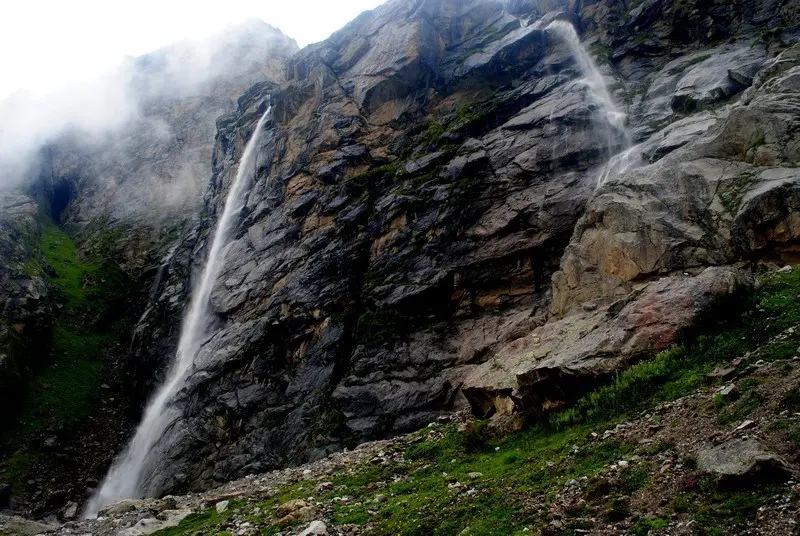
Stand under the spray — this is not a joke and is not only for the mythologically inclined. The mist from a 400 foot waterfall at 11,000 feet is cold and specific and the experience of standing in it — the sound, the cold, the specific quality of high-altitude water in the air — is one of those physical experiences that is difficult to describe and immediately recognisable once you have had it. Walk as close to the base as is safe. Let the spray land. The purity question is between you and the falls.
Sit and look at it for a while — there are almost no other visitors at Vasudhara Falls on most days of the season. The silence of the upper valley — broken only by the sound of the water and the occasional marmot — is a specific quality of mountain silence that requires nothing from you except attention. Sit at the pool below the falls. Give it twenty minutes. The falls will not be rushing anywhere and neither should you.
Look at the peaks above the falls — the surrounding peaks visible from the Vasudhara viewpoint include sections of the Zanskar range that are not visible from Badrinath or Mana. The trail to the falls gives a different angle on the upper valley than any other accessible viewpoint in the area. On a clear morning in September or October the visibility from Vasudhara is extraordinary — the high peaks appear in a clarity that the valley floor below does not always offer.Combine it with the full Mana village experience — the finest Vasudhara visit is part of a full Badrinath and Mana day that includes the early morning darshan at the temple, the Tapt Kund, the drive to Mana, the Bheem Pul and Vyas Gufa, lunch at a Mana dhaba, and then the 5 kilometre trail to Vasudhara in the afternoon. This is a complete day from Joshimath — 53 kilometres of driving and 10 kilometres of walking at altitude, in one of the most extraordinary landscapes in the Indian Himalayas. It requires an early start and good energy. It rewards both.
Things not to do at Vasudhara Falls…
Go past the Army check post. The Vasudhara trail branches from the main path before the Army check post above Mana. The check post marks the boundary of the restricted zone. Do not attempt to go further. The falls are entirely within the open zone and require no approach through the restricted area. If you find yourself at the check post, you have gone too far — turn back and take the Vasudhara branch.
Underestimate the altitude. Vasudhara Falls sits at approximately 11,155 feet — over 3,000 feet above Joshimath and 800 feet above Mana village. The trail is gentle but you are gaining altitude throughout. If you have not acclimatized properly in Joshimath before the Badrinath day, the combination of the long drive, the temple visit, the Mana walk and the Vasudhara trail is a significant altitude exposure for a single day. Eat well, drink water consistently, and go at the pace the altitude sets rather than the pace your watch suggests.
Rush the return to suit the driver’s schedule. The most common reason visitors cut short the Vasudhara visit is that the driver is waiting at Mana and the pressure to return by a certain time removes the patience that the falls require. Agree the timing with your driver before you leave Mana — tell them you will be 3 to 4 hours, and that you will be back when you are back rather than when is convenient. The driver will wait. The falls will not rearrange themselves for a shorter visit.
Attempt the trail in poor weather. The open terrain above Mana village is exposed — no forest cover, no shelter from wind or rain. In the monsoon season, when afternoon cloud and rain are common, the Vasudhara trail can become slippery on the rocky sections and the falls themselves are obscured by cloud. Go in the morning on a clear day, particularly in July and August. If the sky is building cloud by midday, turn back from the trail rather than continuing into deteriorating conditions at altitude.
Best Season for Vasudhara Falls…
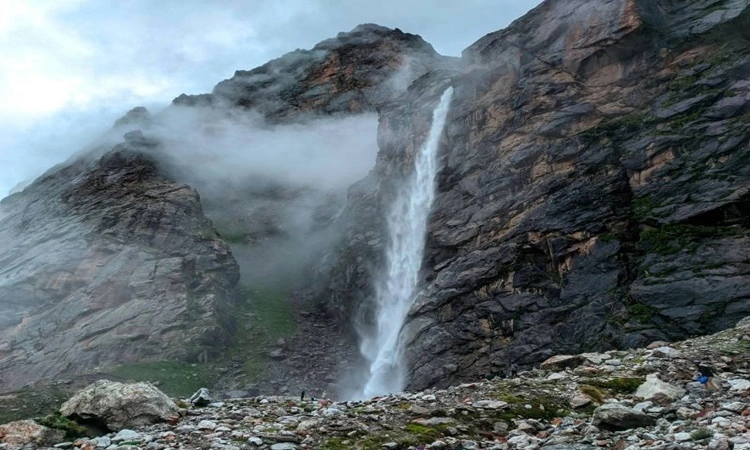
May and June — clear skies and full flow. The falls are at high volume in May and June as winter snowmelt feeds the waterfall at maximum capacity. The sky is clear in May and early June before the monsoon builds. The meadow sections of the trail have early wildflowers. This is the finest combination of water volume and visibility and the best overall season for the Vasudhara walk.
July and August — maximum water, variable sky. The monsoon season produces the highest water volume of the year — Vasudhara in August is thunderous in a way that May’s waterfall is not. The trade-off is cloud cover, which can obscure the surrounding peaks and make the upper trail wet and occasionally slippery. Morning walks in clear windows during July and August are excellent — afternoon visits risk being caught in cloud. Go early and watch the sky.
September and October — the finest overall window. Post-monsoon clarity makes September and October the best season for the views from the Vasudhara trail — the surrounding peaks appear in full definition, the sky is a deep post-monsoon blue, and the water volume, while lower than monsoon peak, is still substantial. The wildflowers in the meadow sections are in their late-season bloom in September. October is the last reliable month before the trail closes with the Badrinath temple season. The finest Vasudhara experience, for those who can choose, is a clear October morning.
November to April — closed. The trail above Mana village is under snow from November and the Badrinath road itself is closed through winter. Vasudhara Falls is a seasonal destination — open when the temple season is open, closed when it is not.
What to Carry — Vasudhara Falls Essentials…
| Water | At least 1.5 litres — no water sources on the trail beyond Mana · do not rely on the falls pool |
| Snacks | Energy bars, dried fruit, nuts · the 10 km round trip at altitude burns more than it feels like |
| Warm layer | A fleece or down jacket — the falls area is cold from the mist and the altitude · even in May |
| Waterproof jacket | Essential in July and August · useful in all months · the mist from the falls will soak light clothing |
| Footwear | Trekking shoes or sturdy walking shoes with grip · the rocky sections above Mana are uneven |
| Sunscreen | SPF 50+ · UV at 11,000 feet is intense · the open terrain above Mana has no shade |
| Camera | The falls, the peaks, the meadow, the marmots — all worth it · bring extra battery in cold months |
| Cash | Carry cash from Joshimath · no ATMs at Mana or Badrinath · needed for dhabas and woolens in Mana |
Planning the Full Day — Joshimath to Vasudhara and Back…
| 6:00 am | Depart Joshimath · 45 km to Badrinath |
| 7:30 am | Arrive Badrinath · Tapt Kund · early morning darshan |
| 9:30 am | Drive or walk 3 km to Mana village · Bheem Pul · Vyas Gufa |
| 10:30 am | Begin Vasudhara Falls trail from Mana · 5 km gentle climb |
| 1:00 pm | Arrive at Vasudhara Falls · time at the falls · lunch (packed or carried) |
| 2:30 pm | Begin return to Mana · 5 km descent |
| 4:30 pm | Back at Mana · chai at the dhaba · woolens if not yet purchased |
| 5:00 pm | Drive back to Badrinath · optional second visit to temple precinct |
| 7:00 pm | Evening aarti at Badrinath (if time and energy allow) |
| 8:00 pm | Depart Badrinath for Joshimath · arrive approximately 9:30 pm |
| Note | This is a long and full day — 15 hours from Joshimath. The version without the evening aarti returns to Joshimath by 6:30 to 7 pm, which is more manageable for most visitors. |
OVERRATED
The purity test as a reason to go or not go. Vasudhara Falls is worth the walk for the waterfall, the alpine terrain, the silence and the views. The mythology of the purity test is a fine piece of mountain storytelling that adds a layer of meaning to the experience. It is not the reason to go, and the fear of being judged impure by a waterfall should not be the reason to stay in the car at Mana. Go for the falls. Receive the mythology as a bonus.
Treating Vasudhara as the addition rather than the main event. Most visitors who do reach Vasudhara treat it as an add-on to the Badrinath day — something they fitted in because they had time and energy left after the temple and Mana. The visitors who enjoy it most are the ones who planned the day around it from the beginning — early Badrinath darshan, quick Mana visit, and then the full afternoon for the trail and the falls without time pressure. When Vasudhara is the plan, it delivers everything it promises. When it is the afterthought, it gets rushed.
Staying at Blackberry Cottages & Resort for your Vasudhara visit…
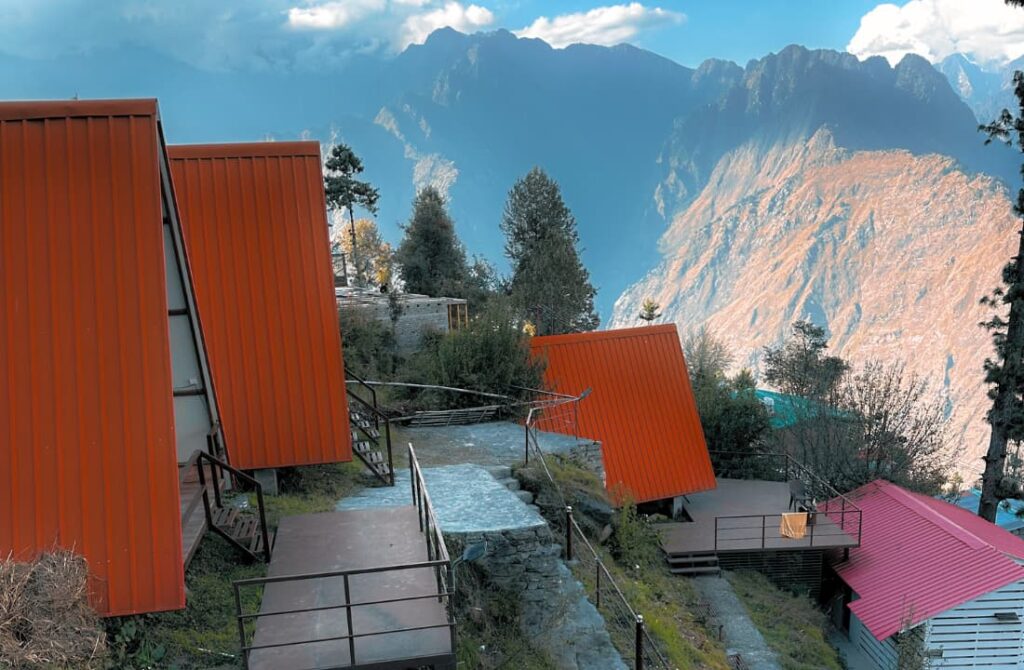
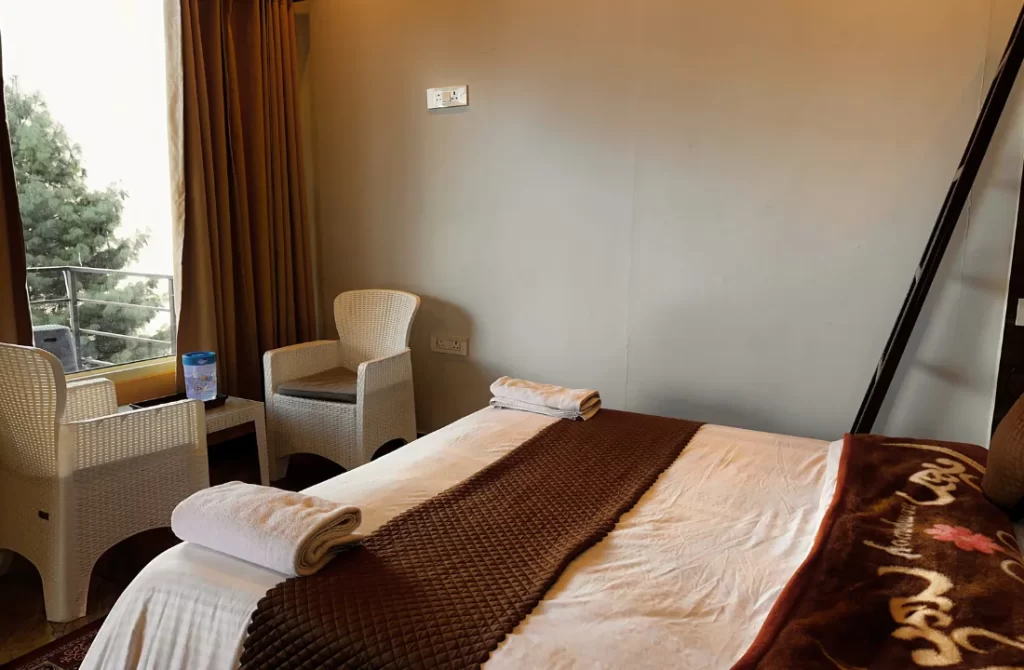
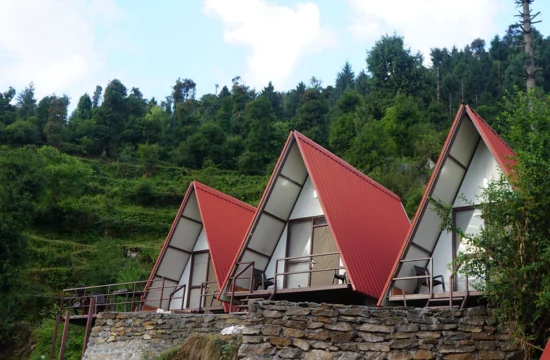
Blackberry Cottages & Resort is at Auli Laga, Joshimath — 53 kilometres from Vasudhara Falls and the natural overnight base for anyone planning the full Badrinath, Mana and Vasudhara day. We arrange early morning vehicles that leave Joshimath by 6 am — the timing that gives you the early darshan at Badrinath, the full Mana village experience, and the afternoon trail to the falls without any part of the day being rushed.
For guests who want to plan the Vasudhara day specifically — the trail timing, what to carry, the driver arrangement, the return timing for the evening aarti — we build the itinerary around the falls rather than treating them as an afterthought. It is, when properly planned, one of the finest single days available from a Joshimath base. We know the trail, the timing, and what each season offers at the falls. Ask us before you go.
Plan your Vasudhara Falls day from Joshimath at blackberrycottagesauli.com or reach us on WhatsApp.
