
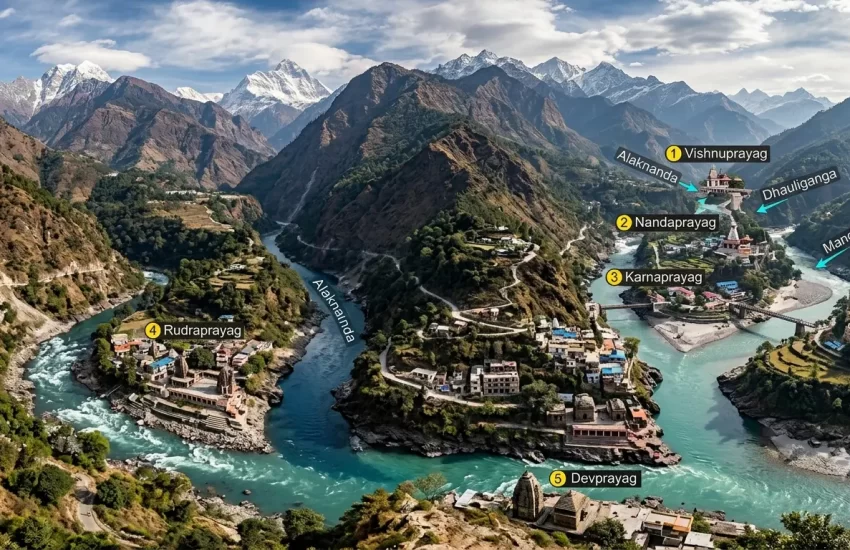
Sometimes a geography lesson is the only way in. In Sanskrit, prayag means a confluence — the meeting point of two rivers — and in the Garhwal Himalayas, the Alaknanda river is joined by five significant tributaries on its journey down from the high mountains to the plains. These five meeting points are known collectively as the Panch Prayag, and they are not simply pretty spots where two rivers happen to join. Each one is considered sacred, associated with specific legends from Hindu mythology, and has been a place of pilgrimage, ritual bathing and quiet reflection for pilgrims travelling this route for centuries.
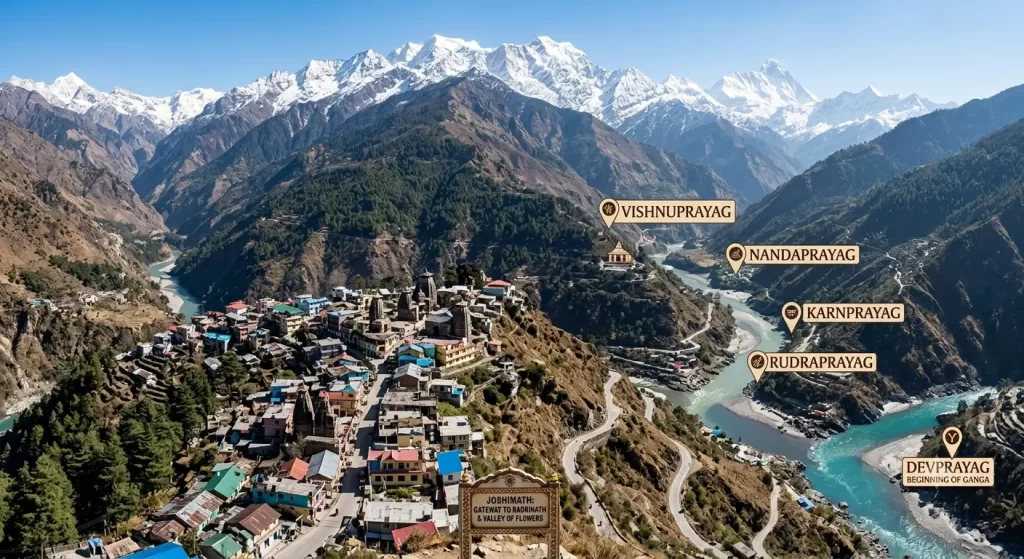
If you have ever driven the road from Rishikesh or Haridwar toward Joshimath and Badrinath, you have already passed through most of them, whether or not you noticed. The road follows the Alaknanda valley almost precisely along the sequence of these five confluences, from Vishnuprayag near Joshimath down to Devprayag, where the Alaknanda meets the Bhagirathi and the river is, from that point on, officially the Ganga. Most travellers treat this stretch as transit time between the real destinations. The Panch Prayag argue, quietly and persistently, that they are wrong about that.
This guide covers all five confluences in order — Vishnuprayag, Nandprayag, Karnaprayag, Rudraprayag and Devprayag — their mythology, their practical significance, and how to actually see them properly on your way to or from Joshimath, rather than sleeping through them the way most road trips do.
The Five Prayags — At a Glance
| Prayag | Rivers that meet | Distance from Joshimath | Known for |
| Vishnuprayag | Alaknanda and Dhauliganga | Approximately 12 km, 20 to 30 minutes | Closest Prayag to Joshimath, associated with Lord Vishnu |
| Nandprayag | Alaknanda and Nandakini | Approximately 40 km, 1 to 1.5 hours | The quietest and least visited of the five |
| Karnaprayag | Alaknanda and Pindar | Approximately 65 km, around 2 hours | Associated with Karna of the Mahabharata |
| Rudraprayag | Alaknanda and Mandakini | Approximately 106 km, 3 to 3.5 hours | Junction for the Kedarnath road; associated with Shiva |
| Devprayag | Alaknanda and Bhagirathi | Approximately 152 km, 4.5 to 5 hours | Where the river officially becomes the Ganga |
Vishnuprayag — Where the Alaknanda Meets the Dhauliganga
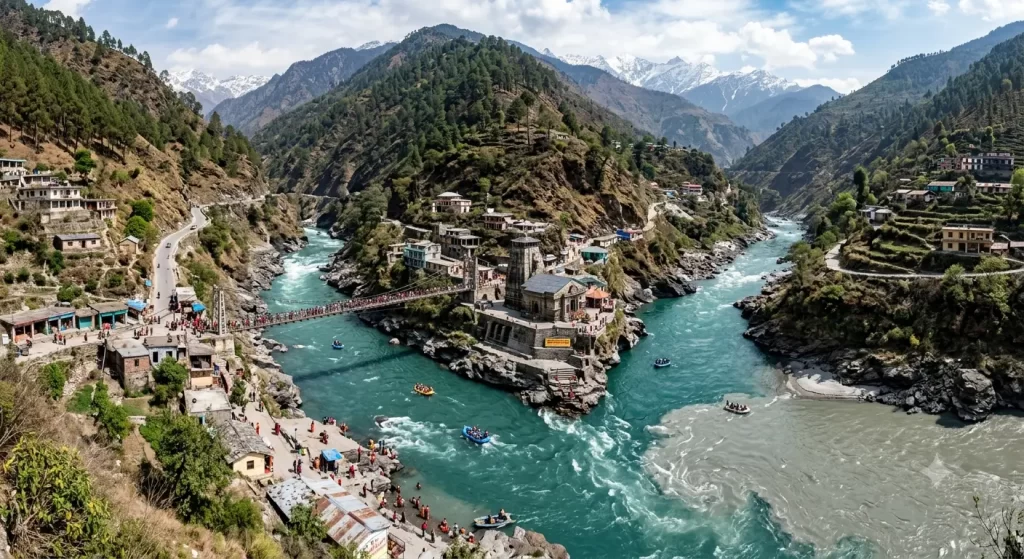
Vishnuprayag is the Prayag closest to Joshimath, roughly 12 kilometres and a 20 to 30 minute drive away, where the Alaknanda is joined by the Dhauliganga flowing down from the Niti valley near the Tibet border. It is, according to tradition, named for the sage Narada, who is said to have performed penance and worshipped Vishnu at this confluence. The setting is dramatic even by the standards of this valley — steep rock walls funnel both rivers into a narrow, turbulent meeting point, and a small temple sits above the confluence. For anyone based in Joshimath, this is the most accessible of the five Prayags and the easiest to build into a half-day outing.
Nandprayag — The Quiet One
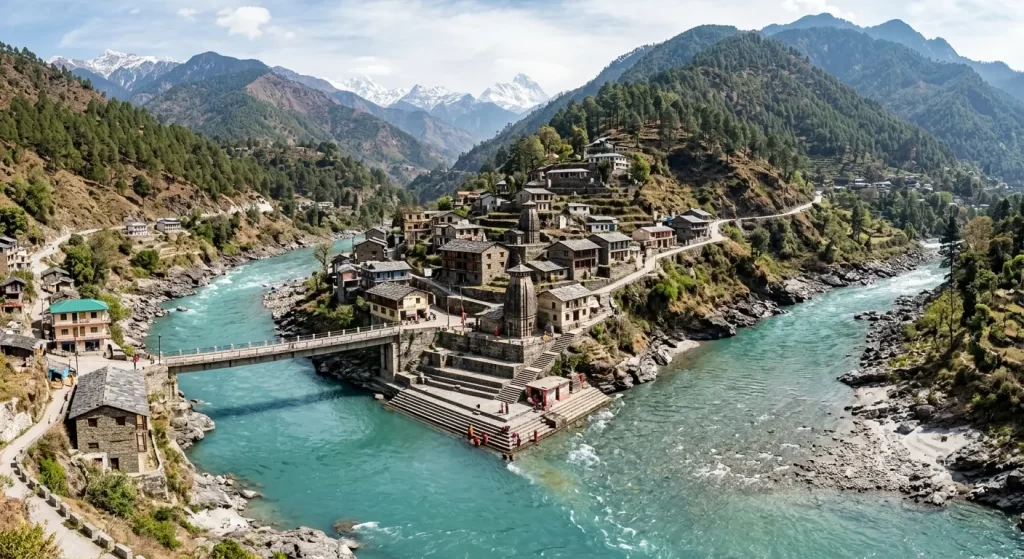
Nandprayag, where the Nandakini meets the Alaknanda, is the Prayag most travellers bypass entirely, and it is honestly a little unfair. Named for King Nanda, who is said to have performed tapasya here, the confluence has a genuinely unhurried quality that the busier Prayags further down the valley do not always retain, particularly outside peak pilgrimage season. If you are travelling with even a small amount of flexibility in your schedule, Nandprayag rewards a short stop precisely because so few people bother to make one.
Karnaprayag — Karna’s Confluence
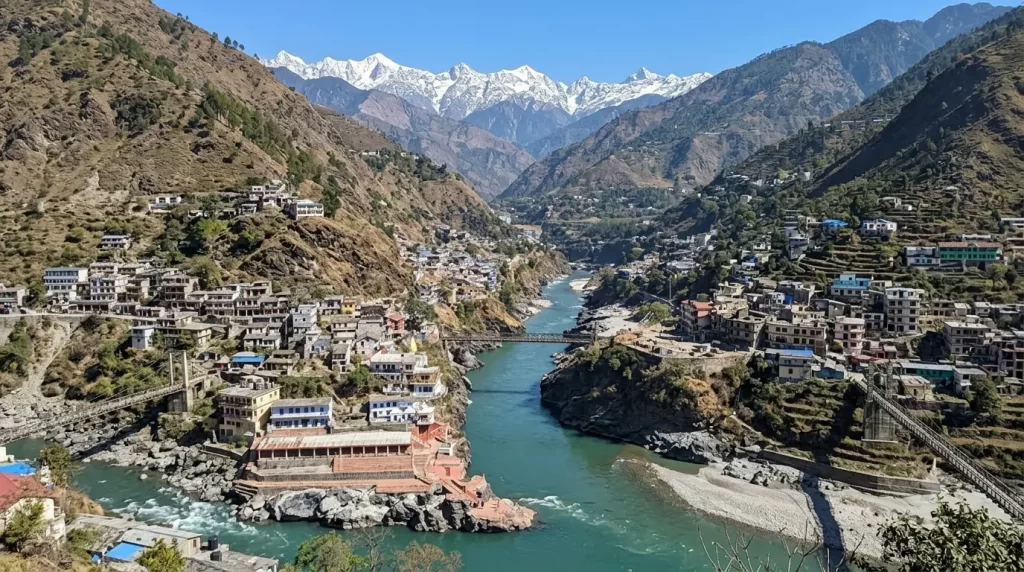
Karnaprayag, where the Pindar river joins the Alaknanda, is named for Karna of the Mahabharata, who according to legend performed tapasya here and is said to have received his armour and earrings from the sun god Surya at this spot. The town itself is larger than Nandprayag and functions as a natural mid-journey stop for travellers on the road to or from Joshimath — a market area with reasonable food options and a ghat below the main road that is quieter and more contemplative than the bustle of the bazaar above suggests.
Rudraprayag — Where the Kedarnath Road Branches
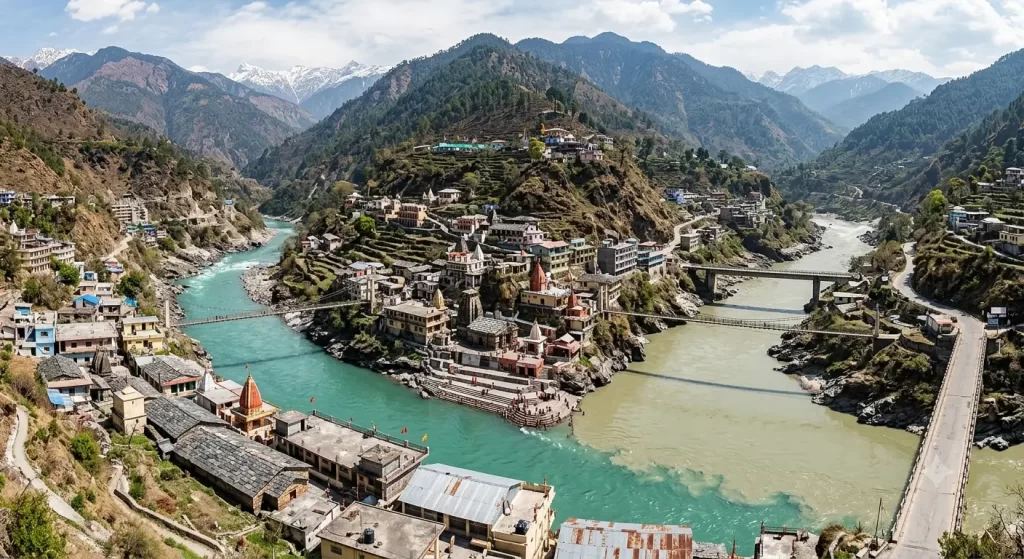
Rudraprayag is where the Mandakini, arriving from Kedarnath, meets the Alaknanda, and it carries a double significance as a result — both a sacred confluence in its own right, associated with Shiva in his fierce Rudra form, and a genuine crossroads on the Char Dham route, since the road to Kedarnath branches away here while the road to Badrinath continues up the Alaknanda valley. The confluence is visible from the bridge crossing the town, and Rudraprayag’s dhabas make it one of the more natural lunch stops on the journey either way.
Devprayag — Where the Ganga Is Born
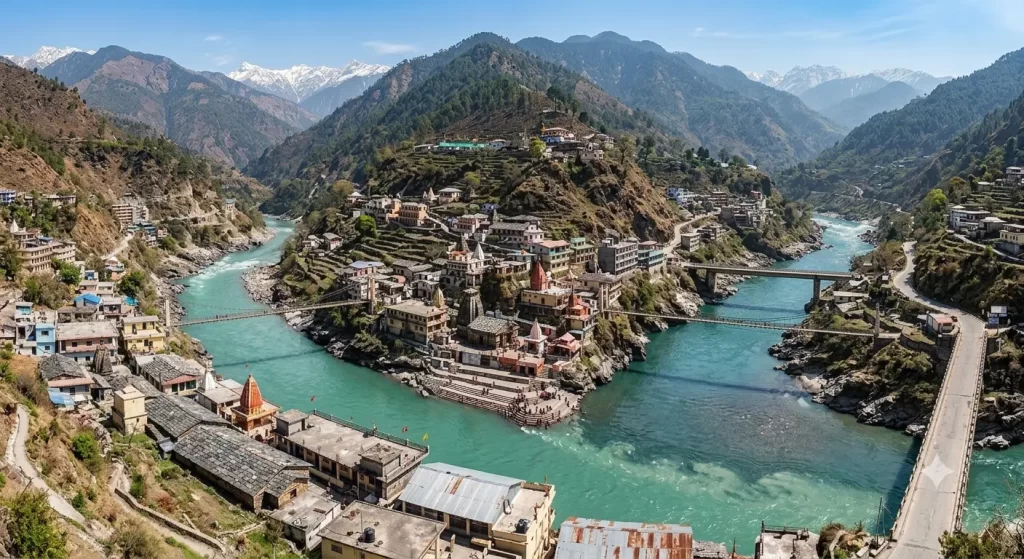
Devprayag is, by most measures, the most significant of the five. Here the Bhagirathi, flowing down from Gangotri, meets the Alaknanda, and the river that continues from this point onward is, by long-standing tradition and by name, the Ganga itself. The confluence is genuinely striking to look at — the Bhagirathi runs pale and clear, the Alaknanda a deeper jade green, and the two colours are visible mixing in the water for some distance below the meeting point. A small temple town sits above the confluence, and the ghats are worth the fifteen minutes it takes to walk down and stand at the water’s edge, at the specific place where, as far as scripture and tradition are concerned, the most sacred river in India actually begins.
Things to Do at the Panch Prayag
Stop at Devprayag even if you are stopping nowhere else. Of the five, this is the one confluence that genuinely justifies a dedicated pause regardless of how tight your schedule is — the birthplace of the Ganga is not a minor stop to skip for the sake of an extra fifteen minutes of driving.
Walk down to the ghats rather than viewing the confluence from the road above. Every one of the five Prayags looks meaningfully different from the water’s edge than it does from a moving vehicle on the bridge or the highway above it. The colour difference between the two rivers, the sound of the water, the specific quality of a place pilgrims have been visiting for centuries — none of this comes through from a car window.
Visit Vishnuprayag as a standalone half-day trip from Joshimath. At 12 kilometres and 20 to 30 minutes away, this is the one Prayag that does not require you to be already travelling the full Rishikesh-to-Joshimath road — it is close enough to visit deliberately, on its own, during a stay in Joshimath.
Ask your driver to stop, if you are travelling by taxi. Most drivers on this route are used to pilgrims wanting a few minutes at each significant confluence and will stop if asked, particularly at Devprayag and Rudraprayag. Ask before you assume the itinerary does not allow it.
Things Not to Do
Treat the Panch Prayag as scenery to be photographed through a car window at speed. A confluence seen at 40 kilometres an hour from a moving vehicle is not meaningfully different from a photograph you could have found online before your trip. The value of these places is in stopping, however briefly.
Rush past Nandprayag and Karnaprayag because they are “the smaller ones.” Devprayag and Rudraprayag get the attention, reasonably, given their scale and significance. But Nandprayag and Karnaprayag are not lesser versions of the same thing — they are their own places, with their own legends, and are frequently more peaceful for exactly the reason they are less visited.
Assume the road journey to Joshimath or Badrinath is simply the price paid to reach the real destination. The Panch Prayag are part of what makes this specific pilgrimage route significant in Hindu tradition, not an inconvenient prelude to it. Treating the journey itself as sacred is, in fact, closer to how this route has traditionally been understood.
OVERRATED
The idea that you need a dedicated day trip to see all five Prayags properly. For most travellers, the five confluences are seen naturally over the course of the road journey between Rishikesh or Haridwar and Joshimath, in either direction. A brief, deliberate stop at each as you pass is sufficient for most visitors — a separate dedicated Panch Prayag tour is only necessary if you specifically want more time at each site than a passing stop allows.
Visiting only Devprayag and skipping the rest because it is “the important one.” Devprayag’s significance is real, but each of the five Prayags carries its own legend and its own specific atmosphere. Skipping the other four because Devprayag is the most famous misses most of what the Panch Prayag concept is actually about — five sacred meetings, not one.
Visiting the Panch Prayag from Blackberry Cottages
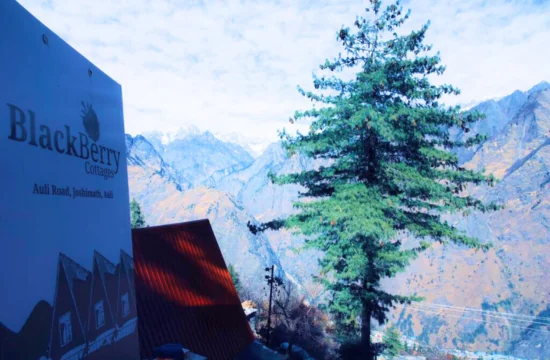
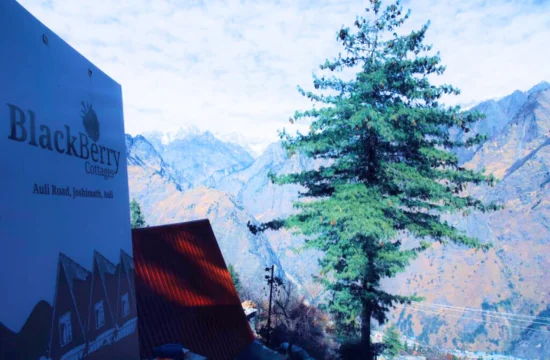
Blackberry Cottages & Resort is at Auli Laga, Joshimath, which puts Vishnuprayag — the closest of the five Prayags — within a short 20 to 30 minute drive, easily arranged as a standalone half-day trip during your stay. If you are travelling to or from Joshimath via Rishikesh or Haridwar, as most visitors do, you will naturally pass Nandprayag, Karnaprayag, Rudraprayag and Devprayag along the way. Our how to reach Joshimath guide covers this exact route in detail, including where each of these confluences falls along the journey and where the more comfortable stopping points are. Ask our team about arranging a Vishnuprayag visit during your stay, or about building a deliberate stop at each of the Prayags into your onward journey rather than letting the road simply carry you past them.
For help planning a Vishnuprayag visit or a Panch Prayag stop on your route, reach us at blackberrycottagesauli.com or on WhatsApp.
